
Android vs iOS Development: Which Career Path Pays Better in India?
Priygop Team
March 2, 2026
For many developers in India, mobile app development represents one of the most visible and practical career paths in technology. Smartphones dominate how users interact with products, services, and platforms, and companies continue to invest heavily in mobile experiences. Yet for students and early-career developers, one question repeatedly surfaces before they even begin: should they build a career in Android development or iOS development?
The confusion is understandable. Salary comparisons circulate widely online, hiring trends shift year to year, and advice often changes depending on who you ask. What is rarely explained clearly is how Android and iOS careers actually differ in India, how compensation really works across experience levels, and what factors matter more than platform choice alone.
This guide examines Android vs iOS development as a long-term career decision, not a short-term salary gamble.
How Mobile Developer Careers Actually Work in India
Before comparing Android and iOS directly, it helps to understand how mobile hiring functions in the Indian job market. Companies rarely hire “mobile developers” in isolation. They hire engineers who can work within product teams, understand backend systems, collaborate with designers, and maintain apps over time.
Recruiters evaluate mobile developers based on three broad signals: platform expertise, depth of fundamentals, and ability to ship maintainable code. Salary outcomes are influenced by these signals far more than by whether the app runs on Android or iOS.
Platform choice shapes opportunity, but it does not override skill quality.
Android Development in the Indian Job Market
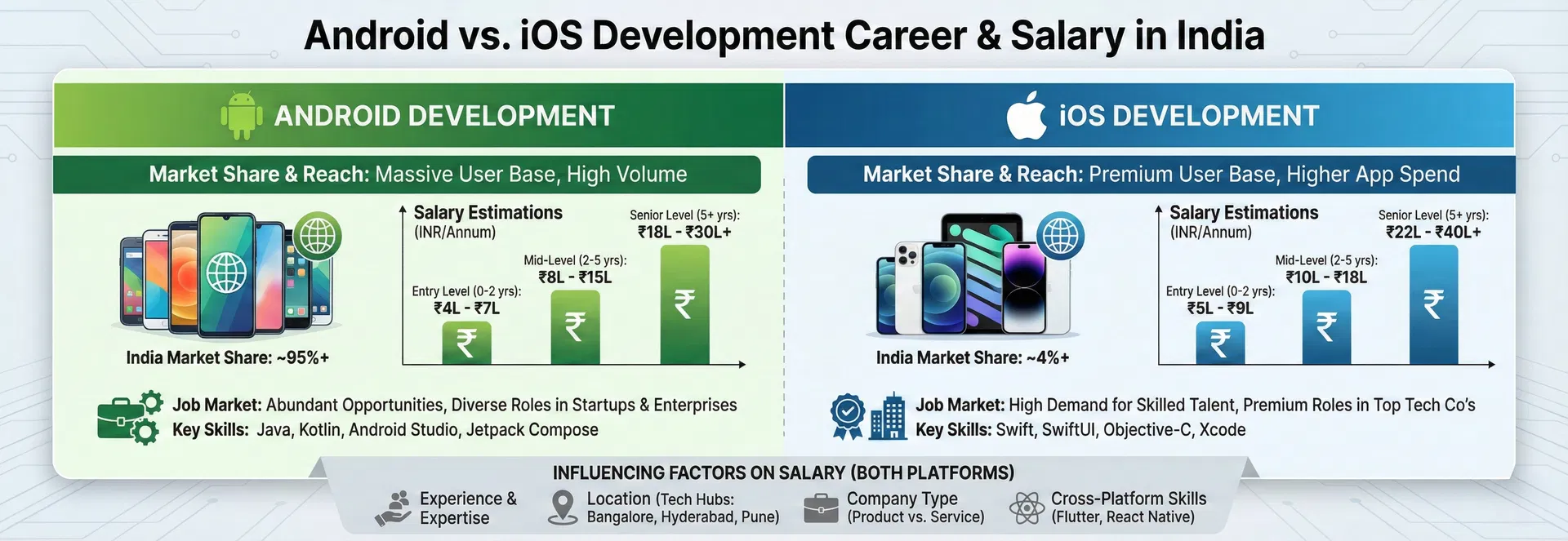
Android dominates the Indian smartphone ecosystem. The vast majority of users in India access apps through Android devices, and this reality drives hiring demand across startups, service companies, and enterprise teams.
Android developers in India often find a larger number of open roles, particularly at the entry and mid levels. Service-based companies, outsourcing firms, and early-stage startups frequently prioritize Android skills because their client products target mass-market users. This makes Android development more accessible for freshers looking for their first role.
However, the larger volume of Android developers also means greater competition. Many candidates enter the market with surface-level Android knowledge, which compresses salaries at the lower end. Compensation rises meaningfully only when developers demonstrate strong architecture skills, performance optimization, and real production experience.
iOS Development in the Indian Job Market
iOS development operates differently. The user base in India is smaller, but the commercial value per user is higher. Product companies, fintech platforms, and global organizations tend to invest more heavily in iOS apps because of purchasing power and international reach.
As a result, iOS roles are fewer in number but often higher in average compensation. Companies hiring iOS developers usually expect tighter adherence to engineering standards, cleaner codebases, and deeper understanding of platform guidelines. This raises the bar for entry but also increases long-term earning potential.
Many iOS roles in India are tied to global teams or remote opportunities, which can further influence salary levels beyond domestic benchmarks.
Salary Comparison: Android vs iOS in India (2026 Reality)
At the fresher level, salary differences between Android and iOS developers are often smaller than online discussions suggest. Android roles may offer slightly lower starting pay on average, but they are more abundant. iOS roles may offer marginally higher packages, but they are fewer and more selective.
At the mid-level, compensation begins to diverge based on company type rather than platform. Product companies and funded startups tend to pay more regardless of whether the role is Android or iOS. Service-based companies typically standardize pay bands across mobile roles.
At the senior level, platform choice matters very little. Senior Android and senior iOS developers with comparable system knowledge, leadership ability, and product impact earn similar compensation. At this stage, salary is driven by architectural ownership and business value, not operating system.
Job Market Demand and Stability
Android development offers broader market coverage and greater job volume in India. This makes it a safer entry point for developers who prioritize employment stability and availability of roles across cities and company sizes.
iOS development offers narrower but often higher-quality opportunities. Developers who establish themselves well can access product-centric roles, international teams, and higher compensation ceilings. The trade-off is fewer openings and higher expectations.
Neither path is inherently safer or riskier. The risk comes from shallow skill development, not from choosing Android or iOS.
Native Development vs Cross-Platform Frameworks
The rise of frameworks like Flutter and React Native has added another layer to the decision. Many companies now expect mobile developers to understand cross-platform tools, particularly in startup environments.
Cross-platform skills can improve employability, especially early in a career. However, developers who rely exclusively on frameworks without understanding native platforms often hit a ceiling. Long-term growth still favors strong native foundations, with cross-platform knowledge layered on top.
In practice, the most resilient mobile developers in India are those who master one native platform deeply and remain adaptable to cross-platform tooling when business needs require it.
Choosing the Right Path as a Fresher
For freshers, the “better” platform is rarely the one with the higher advertised salary. It is the one that aligns with learning style, access to opportunities, and ability to build strong projects.
Android is often better suited for developers who want quicker entry into the industry and exposure to a wide range of real-world use cases. iOS may suit developers who prefer structured ecosystems, are comfortable with stricter guidelines, and are aiming for product-focused environments.
What matters most at this stage is committing to one platform long enough to build depth.
Long-Term Growth Beyond Platform Choice
Mobile development careers do not remain static. Over time, developers move into roles that involve system design, performance optimization, technical leadership, and product decision-making. At that point, the distinction between Android and iOS becomes secondary.
Developers who understand APIs, backend integration, scalability, and user experience grow faster than those who only know how to implement UI features. Platform expertise opens the door, but engineering maturity determines how far the door opens.
Common Mistakes Developers Make When Choosing a Mobile Career
Many developers make the mistake of switching platforms too frequently, chasing perceived salary advantages. Others rely too heavily on frameworks without mastering fundamentals. Some underestimate the importance of code quality, testing, and maintainability in mobile systems.
These mistakes stall growth regardless of whether the developer is working on Android or iOS.
Are Mobile Development Courses Worth It?
Courses can provide structure, especially for beginners who struggle with direction. However, courses alone do not create high-paying careers. Employers look for evidence of problem-solving, production readiness, and sustained learning.
A course is useful only if it leads to strong projects and deeper understanding.
Conclusion
Android vs iOS is not a question of which career pays more in isolation. In India, Android offers more entry-level opportunities, while iOS often offers higher average compensation in product-centric roles. Over time, these differences flatten as experience grows.
The strongest mobile careers are built not on platform selection, but on depth of skills, quality of work, and long-term consistency. Choosing Android or iOS should be a strategic learning decision, not a salary shortcut.
Frequently Asked Questions
Which pays more in India: Android or iOS development?
On average, iOS roles may pay slightly more, but Android offers more job openings. Skill level matters more than platform.
Is mobile app development a good career in India in 2026?
Yes. Demand remains strong for developers who build reliable, scalable mobile applications.
Should beginners learn Flutter or native development first?
Native development builds stronger fundamentals. Cross-platform skills can be added later.
How long does it take to become job-ready as a mobile developer?
With consistent effort, most beginners reach job-ready level in six to nine months.
Can non-CS graduates enter mobile app development?
Yes. Many mobile developers come from non-CS backgrounds with the right projects and skills.