
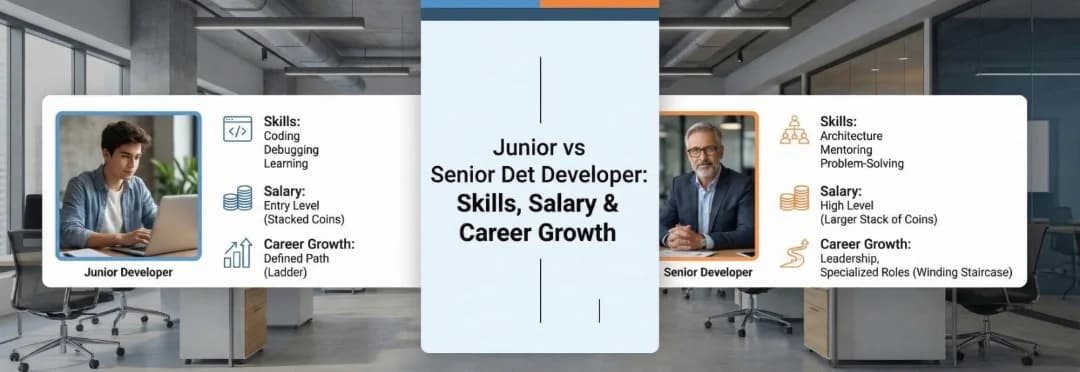
Junior vs Senior Developer: Skills, Salary & Career Growth
Priygop Team
March 5, 2026
In the software industry, career progression often follows a structured path that reflects growing experience, responsibility, and technical depth. One of the most common comparisons developers encounter during their careers is the difference between a junior developer and a senior developer. While the titles may sound straightforward, the reality behind these roles is more nuanced than simply years of experience.
Understanding the distinction between junior vs senior developer roles can help developers plan their careers more effectively. The transition from junior to senior level involves not only improved coding ability but also stronger problem-solving skills, deeper system understanding, and the ability to guide teams through complex technical decisions.
For developers at the beginning of their careers, understanding this progression can clarify expectations and highlight the skills needed to grow within the technology industry. This guide explores the differences between junior and senior developers in terms of responsibilities, skills, salary expectations, and long-term career growth.
Understanding Developer Levels in the Tech Industry
Technology companies often organize engineering roles into levels that represent increasing experience and capability. These levels help companies define responsibilities, salary ranges, and career progression within engineering teams.
The typical tech career ladder includes several stages:
- Junior Developer
- Mid-Level Developer
- Senior Developer
- Tech Lead or Staff Engineer
- Engineering Manager or Architect
Each stage involves broader responsibilities and greater influence over technical decisions. Developers do not move between these levels automatically. Advancement usually depends on demonstrating technical competence, leadership ability, and the capacity to contribute to complex projects.
What Is a Junior Developer?
A junior developer is typically an early-career software engineer who is still learning the practical aspects of building production systems. Most junior developers have recently graduated, completed coding bootcamps, or transitioned into programming from other fields.
Their primary responsibility is writing code under the guidance of more experienced engineers. Junior developers often work on smaller features, bug fixes, and well-defined tasks that help them gain experience with real-world development workflows.
Junior developers spend much of their time learning how professional development environments operate. They become familiar with version control systems, project management tools, and collaborative coding practices used by engineering teams.
Skills Required for Junior Developers
At the junior level, developers are expected to demonstrate basic programming competence. They should understand at least one programming language and be capable of writing functional code to solve specific problems.
Key skills for junior developers often include:
- Understanding programming fundamentals
- Writing clean and readable code
- Debugging basic issues
- Working with version control systems
- Understanding software development workflows
Junior developers also benefit from strong curiosity and willingness to learn. Because the early stage of a developer’s career involves constant learning, adaptability is one of the most valuable traits.
What Is a Senior Developer?
A senior developer is an experienced engineer who has developed strong technical expertise and a deep understanding of software systems. Unlike junior developers, senior engineers are responsible for designing solutions, guiding development teams, and making important architectural decisions.
Senior developers are expected to take ownership of complex systems and ensure that software projects remain scalable, maintainable, and efficient. They often mentor junior developers, review code, and help teams solve challenging technical problems.
Rather than focusing only on individual tasks, senior developers think about how different components interact within a larger system.
Skills Required for Senior Developers
Senior developers possess advanced technical skills along with strong leadership abilities. Their responsibilities go beyond writing code to include system design, performance optimization, and team collaboration.
Important skills for senior developers include:
- Designing scalable software architecture
- Understanding distributed systems
- Conducting thorough code reviews
- Mentoring junior engineers
- Communicating technical decisions clearly
Senior developers must also understand the broader context of software projects, including product requirements, performance considerations, and long-term maintainability.
Junior vs Senior Developer: Key Differences
The difference between junior and senior developers extends beyond years of experience. It involves a shift in perspective and responsibility.
Junior developers focus primarily on implementing tasks assigned to them. Their work often involves learning the codebase, understanding project requirements, and improving technical skills.
Senior developers, on the other hand, focus on solving complex problems and guiding teams. They analyze system architecture, anticipate potential issues, and design solutions that support long-term scalability.
While junior developers concentrate on writing code, senior developers balance coding with strategic decision-making.
Developer Career Growth Path
The transition from junior to senior developer typically occurs gradually over several years. Most developers pass through an intermediate stage often referred to as the mid-level developer role.
During this phase, developers become more independent. They handle larger features, contribute to architectural discussions, and begin mentoring less experienced engineers.
Career growth in software development depends largely on demonstrated ability rather than formal timelines. Developers who actively improve their skills and contribute meaningfully to projects often progress more quickly.
Salary Differences Between Junior and Senior Developers
Salary differences between junior and senior developers reflect their varying levels of responsibility and expertise. Junior developers generally earn entry-level salaries because they require guidance and supervision.
Senior developers command higher salaries because they bring significant experience and contribute to strategic technical decisions. Their ability to solve complex problems and guide teams adds substantial value to organizations.
Salary ranges vary depending on location, company size, and industry sector. However, the gap between junior and senior roles can be significant, reflecting the expertise required for senior positions.
How Developers Move from Junior to Senior Level
Progressing from junior to senior developer requires continuous learning and practical experience. Developers must move beyond basic coding tasks and begin understanding how entire systems operate.
One of the most important steps is learning system design. Senior developers often make decisions about how different components interact, how data flows through systems, and how applications scale as user demand grows.
Developers should also focus on improving their communication skills. Senior engineers frequently collaborate with product managers, designers, and other stakeholders.
Mentoring others is another important aspect of career growth. Developers who help teammates learn and improve often develop leadership skills naturally.
Common Mistakes Developers Make in Career Growth
Many developers assume that simply spending years in a job will automatically lead to promotions. However, experience alone does not guarantee advancement.
One common mistake is focusing only on coding tasks without understanding the broader system architecture. Developers who ignore system design may struggle to transition into senior roles.
Another mistake is avoiding collaboration or communication. Senior developers must work effectively with teams and communicate technical ideas clearly.
Developers who actively seek feedback, learn from experienced engineers, and contribute to team success tend to grow more quickly.
The Importance of Continuous Learning
Technology evolves rapidly, and developers must continuously update their skills to remain competitive. Learning new frameworks, tools, and architectural patterns helps developers stay relevant in the industry.
Senior developers often maintain strong learning habits throughout their careers. They read technical articles, experiment with new technologies, and participate in developer communities.
Continuous learning not only improves technical skills but also helps developers understand emerging industry trends.
The Future of Developer Career Paths
As technology continues advancing, developer roles are becoming increasingly specialized. Some engineers focus on backend systems, while others specialize in cloud infrastructure, artificial intelligence, or cybersecurity.
Despite these specializations, the progression from junior to senior developer remains a common path in software engineering careers.
Developers who combine technical expertise with strong collaboration and leadership skills will continue to thrive in the evolving technology landscape.
Conclusion
Understanding the differences between junior vs senior developer roles helps developers plan their career growth effectively. Junior developers focus on learning fundamentals and gaining practical experience, while senior developers take responsibility for system design, team guidance, and strategic technical decisions.
The transition from junior to senior level requires dedication, continuous learning, and the willingness to take on greater responsibilities. Developers who focus on improving both technical and communication skills can steadily progress through the software developer levels of the technology industry.
By building strong foundations and maintaining a growth mindset, developers can navigate the tech career ladder and achieve long-term success in software development.
Frequently Asked Questions
What is the difference between a junior and senior developer?
Junior developers focus on learning and implementing tasks, while senior developers design systems, guide teams, and solve complex technical problems.
How many years does it take to become a senior developer?
Most developers reach senior level after several years of experience, though timelines vary depending on skills and opportunities.
What skills do senior developers have that juniors don’t?
Senior developers typically have strong system design knowledge, mentoring abilities, and experience solving complex engineering problems.
Do senior developers still write code?
Yes. Senior developers often write code, but they also spend time reviewing code, designing systems, and guiding teams.
Can junior developers grow quickly in their careers?
Yes. Developers who continuously learn, take initiative, and contribute to team success often progress faster in their careers.